So I tried on some very nice pinafore dresses in a well-known chain shop the other day, and I was super giddy because they had a variety of designs, in my size, and in the sale. Winner. And yet, those pesky bust darts got in the way, or failed to be where they should be and consequently I didn't buy anything, because they looked ridiculous.
If any of you are reading this thinking what the hell are bust darts, they're these annoying sort of seams that are added onto shirts, blouses, some tops and dresses to infer where your breasts should fit. Because of course we all have the same sized breasts and we are all the same height, so of course these bust darts are universal......
They're crazy and no wonder women panic so much about sizes and stuff. When you try something on and your boobs come in lower than the bust darts, or the bust darts are further around your sides than they should be, this makes you feel like you're the wrong shape, or your boobs aren't big enough, or you're not tall enough. It's also really annoying when otherwise the item fits well.
I just have to wonder if these bust darts are still necessary. We're not all the same shape even within our clothing size. Of course we're not. We all wear that size differently. So why should we have to fit out bits in where they say so? Our bits should be free to fill whatever space they so choose.
Bloody bust darts. Needless to say, I didn't buy any, despite my deep yearning for a pinafore dress. And it didn't exactly make me want to go and try anything else on.
Moving on to a completely unrelated topic, but one I've ranted about many times, and that is the two wheeled menace to pedestrians: cyclists. Now, my rants are usually concerned with zebra crossings and cyclists, but yesterday I was crossing a small side road that had a pedestrian light on it. I waited for the green man and strolled out, just as the stupid woman cyclist decided she was going to start cycling, after previously waiting nicely at the light. She gave me this look like I'd just stepped in shit and then kicked her in the face with my shitty shoe, and I felt I had to shout at her: I'm on green.
What a dick! Just wait until your frickin' light and stop trying to run over pedestrians!
Okay, I'll keep it short and sweet today. Enjoy your Tuesdays. Watch out for cyclists and bust darts.
Rants.
Tuesday, October 25, 2016

Monday, October 3, 2016
How do you say, I suck, in Italian?
Do you remember in high school when you had that one particular lesson you dreaded? And before each of those lessons you felt a bit sick and whilst in the lesson you willed your teacher not to ask you a question? Well, it's been a while but I'm pretty sure my Monday night Italian classes have become this.
Tonight I was a complete shambles. I didn't understand anything coming out of the teacher's mouth. And for some reason she seemed intent on asking me things and further shaming me. She received mostly a stony silence and a confused expression. There was nothing going on in my brain this evening, or at least nothing particularly helpful.
I turn up every week and I do my homework and I try to do a little extra than that, but that's just not enough. If you can't make the verbs stick in your head, or pluck useful adjectives out of your bum hole, then you're unlikely to succeed. (I'm sure that what it says in the official course outline.)
I just hate feeling really dim. I hate knowing that I'm the thickest in the class. And I know that is not a useful word, phrase or sentiment, but come on, we all do it. We all think, man I hope there's someone worse than me. It doesn't matter the situation, we always hope there will be someone worse at it that us. But tonight, it was me. Tonight, I was the dim wit. I was the one they all looked at and pitied, and I hated every second of it.
It made me angry and frustrated and I'm not embarrassed to say: extremely sad. It allowed my super pessimistic side to shine through and take over. It made me feel defeated, overcome. It made me feel stupid, but then also silly for feeling stupid. I know it is okay to fail. I know it is okay to find things hard and to struggle, but in a ninety minute language class, it's damn embarrassing and quite shaming to be failing for every single minute of it.
Doing supposed 'pair work' didn't help as I was sat next to a right cow who wouldn't even look at me, let alone work with me. So fuck her quite frankly. She might have a better grasp of Sembra and Sembrano, but she's got no fucking manners. At least I wasn't the shittest at that. Hooray for small mercies.
Anyhoo, enough of this self-indulgent, self-hating barrage of nonsense. I was shit. Hopefully next week I'll be less shit. What else can I do but carry on?
Rants out.
Tonight I was a complete shambles. I didn't understand anything coming out of the teacher's mouth. And for some reason she seemed intent on asking me things and further shaming me. She received mostly a stony silence and a confused expression. There was nothing going on in my brain this evening, or at least nothing particularly helpful.
I turn up every week and I do my homework and I try to do a little extra than that, but that's just not enough. If you can't make the verbs stick in your head, or pluck useful adjectives out of your bum hole, then you're unlikely to succeed. (I'm sure that what it says in the official course outline.)
I just hate feeling really dim. I hate knowing that I'm the thickest in the class. And I know that is not a useful word, phrase or sentiment, but come on, we all do it. We all think, man I hope there's someone worse than me. It doesn't matter the situation, we always hope there will be someone worse at it that us. But tonight, it was me. Tonight, I was the dim wit. I was the one they all looked at and pitied, and I hated every second of it.
It made me angry and frustrated and I'm not embarrassed to say: extremely sad. It allowed my super pessimistic side to shine through and take over. It made me feel defeated, overcome. It made me feel stupid, but then also silly for feeling stupid. I know it is okay to fail. I know it is okay to find things hard and to struggle, but in a ninety minute language class, it's damn embarrassing and quite shaming to be failing for every single minute of it.
Doing supposed 'pair work' didn't help as I was sat next to a right cow who wouldn't even look at me, let alone work with me. So fuck her quite frankly. She might have a better grasp of Sembra and Sembrano, but she's got no fucking manners. At least I wasn't the shittest at that. Hooray for small mercies.
Anyhoo, enough of this self-indulgent, self-hating barrage of nonsense. I was shit. Hopefully next week I'll be less shit. What else can I do but carry on?
Rants out.
Monday, September 5, 2016
Tech Issues
Morning. I'm trying not to cave in to the desire to fling Albus - my laptop - out of the balcony window. It's not his fault. He's been updated and upgraded to Windows 10 - albeit about 3 days before the deadline, but still...... - and he's fighting fit. What's ticking me off if the Apple Music Festival links that are being absolute wankers. So I click on the link and it tells me I need to download the latest version of iTunes which I did last week. So then I go through my own iTunes account and at least I can reach the store. Eventually I find the Apple Music Festival banner and then it all goes tits up again. No network connection. Say what? I'm on the pissing internet you remboid. How the hell can I have no internet connection? So I keep clicking on the Get Tickets button and guess what? No frickin' network connection. Apparently.
So of course there can't possibly be a network connection. And I can't possibly be on the internet currently writing a blog. No. It's all an illusion. Of course Apple is right. Argh! The same happened last year and in the end I gave up - not that I would have been lucky enough to win tickets anyway, but still, what the feckles does Apple Music have against me?
Fuming! They are denying my access to Elton and Britney tickets. This is unacceptable!
And in other tech news, google photos are evil. They have this great feature where you can search for a particular object, animal, etc, within your photographs. So if you want to find all your photographs with clouds on, then you can. Just search clouds and voila! But when you search whales, because you're reminiscing about whale watching, you come up with Orca whales and Humpback whales and .......Oh, what's this, a picture of me in the swimming pool. Excuse me. Are you saying I'm a whale? Google, google, google. I'm disappointed in you. I'm a woman, I have enough complexes thank you very much, without being a search result for whales. And I wasn't the only human mistaken for a large sea mammal, no, A's mum was also captured in the sea as a whale. Charming.
Technology itself is being offensive. Wow. And people wonder why I revert back to the pen and paper. They've never called me a whale before.
Rants
So of course there can't possibly be a network connection. And I can't possibly be on the internet currently writing a blog. No. It's all an illusion. Of course Apple is right. Argh! The same happened last year and in the end I gave up - not that I would have been lucky enough to win tickets anyway, but still, what the feckles does Apple Music have against me?
Fuming! They are denying my access to Elton and Britney tickets. This is unacceptable!
And in other tech news, google photos are evil. They have this great feature where you can search for a particular object, animal, etc, within your photographs. So if you want to find all your photographs with clouds on, then you can. Just search clouds and voila! But when you search whales, because you're reminiscing about whale watching, you come up with Orca whales and Humpback whales and .......Oh, what's this, a picture of me in the swimming pool. Excuse me. Are you saying I'm a whale? Google, google, google. I'm disappointed in you. I'm a woman, I have enough complexes thank you very much, without being a search result for whales. And I wasn't the only human mistaken for a large sea mammal, no, A's mum was also captured in the sea as a whale. Charming.
Technology itself is being offensive. Wow. And people wonder why I revert back to the pen and paper. They've never called me a whale before.
Rants
Monday, August 29, 2016
YALC 2016 - Day 3
Exactly a month after YALC 2016 started, I will finally finish the blogging. Hooray you all cry, me included, so let's get this bad boy done because there's only eleven months till the next YALC.
With the majority of the afternoon and latter stages of YALC Day 3 taken over by the Harry Potter Birthday Party, all the panels and talks were in the morning and early afternoon starting with a line-up of eight debut YA authors. Yes that's right, eight of them, all desperate to tell us about their books and very kindly offering advice to the newbie writers in the audience. Apologies that in the excitement I forgot to take a picture of their shiny debut faces, but let me introduce you to the new kids on the block.
Pete Kalu, author of Silent Striker, part of a series of standalone books with football as the connecting element. The books deal with racism, bullying, hearing loss, identity and gender, all interwoven with characters that love football.
Harriet Reuter-Hapgood, author of The Square Root of Summer. This time travelling, 'quantum physics romance' is a book I have wanted to get my hands on since I saw her agent/author talk at YALC last year.
Claire Hennessy, author of UKYA debut Nothing Tastes as Good, (She has been previously published many YA titles in Ireland). Think ghosts and weight loss and issues of appearance and acceptance, feeding in mental health and rounding it all off with a dark witty bow.
Chris Vick, author of Kook, which I was given as a free gift in my YALC goodie bag. Looking forward to reading that one. Kook is a tale of surfing and a love all-consuming that can drag you down to the depths. It packs an emotional punch and involves the characters getting in plenty of trouble.
Natalie Flynn, author of Deepest Cut, is a book with a mute protagonist, plagued with guilt after the OD death of a friend. She describes it as, 'dark but fun.'
Martin Stewart, author of the fantasy novel, Riverkeep, a wild adventure story with a hideous river monster, a quest and that nagging responsibility of taking over the family business.
Rhian Ivory, author of The Boy Who Drew the Future, the story of two boys a hundred a fifty years apart in time that can both draw the future, and the curse it brings to their lives.
Julie Gray, author of The Otherlife, a story about the dark in all of us. A supernatural tale of Norse gods and two opposing worlds co-existing.
Together, with the guiding hand of chair and host Luke Franks from Maximum Pop!, the authors collectively framed the outline for 'the perfect YA book' creating characters, plot lines, opening scenes and the grand finale. Far too much Beiber for my liking, but a hilarious mini collaboration.
We then heard about the authors' challenges, what it was like to be published, when you should send to agents and lots of practical advice for burgeoning writers. Here are some of their best bits of advice:


With the majority of the afternoon and latter stages of YALC Day 3 taken over by the Harry Potter Birthday Party, all the panels and talks were in the morning and early afternoon starting with a line-up of eight debut YA authors. Yes that's right, eight of them, all desperate to tell us about their books and very kindly offering advice to the newbie writers in the audience. Apologies that in the excitement I forgot to take a picture of their shiny debut faces, but let me introduce you to the new kids on the block.
Pete Kalu, author of Silent Striker, part of a series of standalone books with football as the connecting element. The books deal with racism, bullying, hearing loss, identity and gender, all interwoven with characters that love football.
Harriet Reuter-Hapgood, author of The Square Root of Summer. This time travelling, 'quantum physics romance' is a book I have wanted to get my hands on since I saw her agent/author talk at YALC last year.
Claire Hennessy, author of UKYA debut Nothing Tastes as Good, (She has been previously published many YA titles in Ireland). Think ghosts and weight loss and issues of appearance and acceptance, feeding in mental health and rounding it all off with a dark witty bow.
Chris Vick, author of Kook, which I was given as a free gift in my YALC goodie bag. Looking forward to reading that one. Kook is a tale of surfing and a love all-consuming that can drag you down to the depths. It packs an emotional punch and involves the characters getting in plenty of trouble.
Natalie Flynn, author of Deepest Cut, is a book with a mute protagonist, plagued with guilt after the OD death of a friend. She describes it as, 'dark but fun.'
Martin Stewart, author of the fantasy novel, Riverkeep, a wild adventure story with a hideous river monster, a quest and that nagging responsibility of taking over the family business.
Rhian Ivory, author of The Boy Who Drew the Future, the story of two boys a hundred a fifty years apart in time that can both draw the future, and the curse it brings to their lives.
Julie Gray, author of The Otherlife, a story about the dark in all of us. A supernatural tale of Norse gods and two opposing worlds co-existing.
Together, with the guiding hand of chair and host Luke Franks from Maximum Pop!, the authors collectively framed the outline for 'the perfect YA book' creating characters, plot lines, opening scenes and the grand finale. Far too much Beiber for my liking, but a hilarious mini collaboration.
We then heard about the authors' challenges, what it was like to be published, when you should send to agents and lots of practical advice for burgeoning writers. Here are some of their best bits of advice:
- Martin: When editing, 'be prepared to give up on stuff.' But also keep things you take out as they may be used in another book.
- Chris: 'Work out what you want to say as clearly as possible.' 'Keep it relatively simple.'
- Pete: 'Write the ending first.' 'Have fun and enjoy yourself.'
- Harriet: 'Have a very comfortable chair.' And, 'always back up your work.'
- Claire: 'Caffeine!' 'Passion and enthusiasm are essential.'
- Natalie: 'Schedule for meltdowns.' 'Don't give up. Keep practising. Be patient.'
- Rhian: 'Embrace failure,' your first draft will be awful, but 'never say you're stupid.'
- Julie: 'Don't get too hung up on word count.'
Finally Rhian told us about the text to speech function on the Kindle, where you can actually listen to your book as an audio book. So she listens to her book before considering sending it out to an agent or editor. Thanks for that gem, Rhian. I had no idea you could do that.
It was a delight to listen to so many new voices in YA and how diverse and truly different all these books are. The reading pile just keeps on growing. Good luck with your debut offerings and even greater luck for the evil second book writing.
Next up was the Ask YALC event, where members of the audience had submitted certain issues or problems they were facing, and a panel of YA authors would do their best to offer some advice or point them in the direction of a book that could help. I won't go through all the problems and the responses, but I will tell you that Juno Dawson, Holly Borne and Rosalind Jana were our authors, with Gemma Cairney as chair. They managed to get through several audience problems:
- In love with her best friend (who is also female). Should she tell her?
- Loss of a parent. What book would help a friend through this loss?
- Making friends at YALC. Why is it so hard?
- Being blanked by your best friend
- Wanting to know more about mental health and depression, are there some books you could recommend?
- Exam stress. Sometimes I feel like the only one who feels like this.
- Finding YALC overwhelming.
- The best way to recover from a book hangover.
There was also talk of the inspirations of the authors themselves and much talk around gender issues and stereotyping. It was a well-attended event and I hope it gave support to those who needed it. Times change and technology progresses, but most of these YA issues have been constant over generations and will continue to be long into the future.

From left to right: Gemma Cairney, Rosalind Jana, Juno Dawson, Holly Borne.
The third and definitely one of the biggest panels of the day featured Frances Hardinge, Philip Reeve and Tanya Landman, three very different writers with very different subject matter who complimented each other perfectly and provided a captivating and often hilarious panel.
What first drew you to writing?
Frances was writing short stories for adults when a friend realised her work was probably more suited to Children's/YA. Her friend stole the chapters and sent them off. 'I am very grateful to this friend of mine.'
Tanya used to keep a pet pig. Her first book was about a pig going for slaughter. Drawing on her own experiences.
Philip started as an illustrator. He talks of being 'influenced by everything around us.' And he 'wanted to write on a huge scale.' When he was illustrating at Scholastic he was able to get some writing their way.
Settings.
Philip definitely prefers fantasy. He finds it 'satisfying creating worlds.' He enjoys 'choosing the elements' to the story and then piling in 'anything you want' in order to make it work.
Frances chooses fun and often 'insane premise[s]' for her books. She uses 'elements of historical facts' to give a piece 'solidity' and likes to 'exaggerate.' She loves fantasy because 'you can't be wrong.'
Tanya usually works within a 'historical framework.' Her books are often based on real incidents and can be subject to criticism if she gets any of the historical facts wrong.
Research.
When researching for her books, Tanya does a lot of reading around her historical moment. She likes to use google maps and the Internet as there is 'so much access' to so many resources. She also admits to owning lots of books on the American Civil War and the weaponry.
Frances has been as far as visiting volcanoes for research into her books. She does a lot of reading too and likes to explore the gruesome in her books too. She has seen a lot of post-mortem photography during her research and for Cuckoo Song quizzed the London Transport Museum about what trams were like in the 1920's.
Philip says he 'doesn't really do any' research. He reads a lot and enjoys stuff and facts, but he admits he's 'not that planned.' He makes most of it up. For his recent YA series Railhead, it was mainly his 'experience of trains' that got him started rather than a huge research project.
Would you ever want to write a contemporary, realistic story?
Philip says, 'no. I don't want to.' He says it's not possible at the moment and something more realistic is 'not in focus yet.'
Frances says she 'can't rule it out,' but that she normally writes quite 'weird stories' and that is the way in which she 'perceives reality.'
Rebellious girls and feminism in the books and the characters.
Frances offers 'no manifesto'. She is not writing to be bluntly feminist, her characters are born from the story and it is all about the story. She admits to being 'fascinated and troubled by the state of the world,' and being 'allergic to unfairness.'
Tanya's strong female characters are infused from her youth when it was all about boys having adventures. Why couldn't girls have them too? She talked about the frustrations of the westerns she used to watch where the women were only good for three things: screaming, being rescued and falling down.
Philip talks about his extensive reading as a child and how when he moved on to 'grown-up books' they seemed to be written by or staring female characters. So he started to associate 'proper books' with real life and women. His series Railhead is 'gender equal but class is the issue.'
Influences.
Philip sees 'everything you consume culturally' as an influence. As a teen he read a lot of sci-fi and enjoyed fantasy and mythology. He mentions Star Wars as a big influence.
Tanya again talked of 'an anger against unfairness' and these westerns that were 'white washed versions of history.' She found anything with a sense of injustice at the heart of it, as inspiration and influence.
Frances devoured books and remembers such authors as: Alan Garner, Nicholas Fisk and Tolkien, lovingly. She also had a fascination with black and white murder mystery films from the 30's and read a lot of Sherlock Holmes, Agatha Christie and Victorian novels.
Current Projects.
Frances told us of her upcoming historical fantasy, featuring an 'angry dead bear' set around the Spanish Civil War.
Tanya wouldn't reveal any spoilers, but said her new book had been sent to the editor and is due out in 2017.
Philip's Railhead series is a 'train based space opera.' Book two is out this October and he is currently writing Railhead 3. So watch this space.

From left to right: Imogen Russell Williams, Philip Reeve, Tanya Landman, Frances Hardinge.
This was a great panels with three big personalities and a nice chance to see Frances and her legendary hat. Thank you also to Imogen Russell Williams for the questions.
Now to my fourth and final YALC panel on the final day of YALC 2016. The end is nigh.
The Morally Complicated YA panel, drew a huge crowd, possibly the largest crowd I'd seen all weekend. And rightly so. This meaty discussion ranged from drugs, rape, prostitution, violence, sex and murder, and featured a cornucopia of newer and more established names in YA.
Melvin Burgess celebrating 20 years of his novel Junk.
Emerald Fennell introducing her third novel: Monsters.
Louise O'Neill, the Irish author of Asking for It and Only Ever Yours.
Manuela Salvi, an Italian author banned from publishing in her own country due to the subject matter of her book: Girl Detached, instead moving to England and publishing in English.
Are you morally complicated?
Melvin says he goes out there to 'educate'. Yes his subject matter is often complicated but he uses morals and ethics to infuse his stories. He's not glorifying anything, he is simply writing about things that happen and should be addressed.
Louise finds that if you have a female protagonist people want her to be likeable. And if they are not particularly likeable, then more questions are raised. But Louise goes for real life situations and real life characters.
Emerald adds that she is being truthful. She is not going out of her way to be unnecessarily morally complicated but it is about the story and the truth of that story and the characters.
Manuela talks of gatekeepers and the controversy that sometimes happen when you are writing about 'difficult topics.' She says, 'literature can be a way out,' and can give us, 'different ways to understand.'
What do you think about banning books?
Manuela has been banned in her home country. She talked about censorship being quite 'covert' in that it isn't given a wide knowledge, it is kept hush hush. It is them 'ignoring something they don't want to discuss.' Of course it upset her as, 'we assume we are free.' She has since devoted her PhD to censorship.
Emerald sees it as 'appalling.'
Louise says it is something not really talked about but that in Ireland 'books and movies were still banned up to the 80's.' She also talked about the fact that abortion is still illegal in Ireland and that there were some art works up saying repeal the 8th, and they have started censoring the art on the streets. She spoke of the danger and worry of 'silencing artists.'
Melvin said it is 'always done quietly.' He said he's had his books 'wrapped in brown paper', 'kept under the counter,' or even in 'a separate room in the library.' He also spoke of there being 'no funding for those books for cinema or TV.' You are essentially 'exiled from TV and Movies on a global field.' Again this silencing of the artists voice.
Louise then added that violence is seen as fine but sex is still not acceptable. But wouldn't you rather your children grow up knowing that they can have a healthy, happy sexual relationship?
Violence and the exploitation of women.
Melvin was perhaps the exception here as his books did not contain violence towards women or the exploitation of women, but he offered that this could be because he grew up in the 70's feminist movement and from that was careful not to write his female characters as victims.
Emerald talked about 'everyday sexism' and that women just have to 'bear it.' It often brings 'shame on women', but she hopes it is getting better.
Louise has received a lot of online abuse and death threats and refuses 'to shut up.' She will not have her voice silenced. She says harassment and sexism are a daily occurrence for many women and it has to be stopped.
Manuela talked about the media influence and advertising, and how fake it all is. She says there is a lot of anxiety over image and during her years as a teacher of graphic design she was shocked how much her students thought the models were perfect, and that they had no idea about air brushing and photoshop. All the social media and selfies are almost forcing kids 'to be sexy,' or to want to be sexy.
Fantasy or Dystopia Vs Real World.
Louise's debut YA Only Ever Yours was a harsh dystopia. She said the adults were shocked, whereas the teens could totally see it as real life. There is a freedom in dystopian writing, that of exaggeration.
Melvin said that dystopia can be quite 'liberating' and can have 'unusual structures.' But obviously it depends on the story you are writing.
Emerald wrote her newest 'psychological dystopia,' Monsters, in first person. One of the main characters also has a mental health issue and the reader 'never know[s] what is real.'
Manuela added that there can be 'dystopian elements in the real world,' and offered 'reality as a possible dystopia.'

From left to right: Translator (sorry I didn't catch her name), Manuela Silva, Emerald Fennell, Louise O'Neill, Melvin Burgess and Mairi Stone.
What a great panel to finish on, lots to think about there. And what a stunning weekend of panels, events and general YA literary wonder. Thanks to all the organisers and thanks again to LFCC for the shared space. And a huge thank you to each and every author who graced the stage, who got a numb bum from hours of signing and chatting to the fans, and who imparted their wisdom and advice to the next generation of authors out there. You inspire and make people believe they can do it too.
*Sigh of relief*. Now I have 11 months to recover until the next YALC. Already can't wait.
Thanks again for reading. Regular rants will continue forthwith.
Rants
Sunday, August 21, 2016
YALC 2016: Day 2
Following on from last week's blog, here is day 2 of YALC 2016, better late than never, I hope.
I would like to point out the wonder of the YALC queue, this year being open all day, every day. Genius. You never had to queue very long and if you were there for the weekend and had a wristband, then you only had to queue the first day and the other days you just waltz in like a VIP. Not too shabby YALC. Not too shabby.
As I attended six panels in a row on the Saturday, I'd probably better run straight into it. *googles how to condense 36 pages of A4 notes into a concise and fun blog* Eek.
Kicking off Day 2 with a blast of politics and protest came the Rebellion and Resistance panel, with some fantastic authors from the UK and US.
Alwyn Hamilton: Author of Rebel of the Sands.
Julie Mayhew: Author of The Big Lie.
Simon Mayo: Author of Blame.
Kass Morgan: Author of The 100 series.
Anna James: Chair of the panel.


The authors started by introducing their latest books detailing the specific rebellion and revolution running through them.
Julie: Her novel The Big Lie has a bi-sexual ice skating Nazi protagonist..... okay, how can you not want to read this? It's a sort of contemporary, if the Nazi's won the war novel, and gives a bit of weight to what the kids were doing during the war. For Julie it was about the rebellion that happens in the mind, and the idea of someone or something changing your mind against what you previously believed.
Alwyn: Rebel of the Sands, the first of a trilogy is a rebellion in the desert to overturn the Sultan's reign. Her starting point was, 'girl with a gun' and the French revolution played a huge part in her upbringing and education.
Simon: Simon's novel, Blame, centres on heritage criminals and the idea that you can be held accountable for another generations' crimes. He talked about the 'lack of rebellion' in his book and how the criminals are contained and controlled by the prison and the state.
Kass: The 100 series. For Kass it was all about rebellion right from the start. Rebellion against the adults in charge, rebellion against each other. But also rebellion for love and rebellion for protection. It's about what we have to do to survive. Set in the future, using juvenile delinquents as expendables, we see the harsh realities of a post-apocalyptic earth.
Time and Setting.
Julie: Set in 2015, addressing now through Nazism. Didn't want a historical setting, wanted it contemporary and to show how we are still owned by society.
Alwyn: Writing fantasy you get to be epic! She talked about being able to do bigger things with the politics of a fantasy world, and also how not being locked into a specific time period gives you a lot of flexibility. It has a western/Arabian nights feel to it.
Simon: Set only a few years in the future. Was it a premonition? Because in the book Britain had to be out of the EU for the heritage crime to work. And lo and behold, we're out of Europe. Creepy.
Kass: Her books are set around 300 years in the future, the length of time it would take for a nuclear winter to last.
Darkness and violence.
This is a topic that comes up all the time in almost every YA panel, but there were some interesting answers here. All the authors agreed that they had to be true to the story and they had to make it real, but that they wouldn't be gratuitously violent just for the sake of it. Simon added that 'it's shocking where it needs to be shocking.' His book set in a prison, has a prison riot, which of course would be terrifying. it was logical to the story, but 'still has a moral compass.' He did talk of having to tone it down from earlier drafts as it was deemed at points too violent.
Kass admits she 'wasn't concerned' about the darkness and violence as it was integral to the world in which the book is set. Alwyn added that you 'can't gloss over stuff,' and that the teenage mind is often darker than the adult mind. Julie talked about how violence was always accepted in her books, but sex was still not okay. She honoured her publisher, hot key and said they were 'super brave' to take on her project. She also said, 'the real world is worse than the world in the book.'
Something to take away....
The authors were asked about specific messages in their books, or things they would like the reader to take away with them:
Alwyn: Everyone will have 'different opinions', 'I can't control what people take out of it.'
Julie: I want them to 'question the things they accept as normal.'
Kass: 'Bravery, in different forms.' 'Not just action.'
Simon: 'I haven't written a message book.' His book is more about 'shifting blame.'
If you had your own revolution, who would be in it?
Alwyn would go Ocean's 11 style, with everyone having different skills. She would also like Hermione Granger and Kat from High Society.
Julie: Clem, from her novel The Big Lie and the A-team.
Kass: Neville Longbottom (violence as a last resort). And Anne Shirley.
Simon: 'I'll take all of those and Lyra from His Dark Materials.'
A wonderful lead off panel for day 2 of YALC. Great authors, great questions and great insight into some more books for the reading pile. One down, five to go..........
Squad Goals: Friendship in YA
This panel filled with a litany of female authors was centred around female friendships in YA, and why it is so important for young girls to have female friendships and not just focus on romantic relationships. They also talked about if girls and boys can be platonic friends and gave us their favourite fictional friends. So here are some of their best bits.
Holly Borne: Author of The Spinster Club Trilogy.


Eugene: The Sign of One is his debut novel and the first in a trilogy. It takes place on a 'dump world' in space, where twins are considered a curse. He is a twin himself.
What is sci-fi?
Malorie: Something that is 'scientifically possible or probable' in the future. It's alternate realities and multiverses.
James: 'Fine line between sci-fi and Fantasy.' 'Fantasy is beyond the possible,' whereas sci-fi sees us 'plausibly getting to that situation.'
Eugene: Eugene finds that the 'science' in sci-fi can put people off and that the term isn't always useful.
Dystopian warnings for the future?
James' dystopia revolves around climate change and social structures. He leads with the idea that 'nothing's wonderful' and that 'things are getting worse.'
Eugene talked of the practicality of dystopia, because a utopia is just not interesting. Also, you can exaggerate things within a dystopia.
Malorie's dystopia is more class based, with the 'haves and the have nots'. She talked about art and culture costing money and how not everyone can access it. Her book is set 150 years in the future.
Why Space?
Malorie originally set her Othello remake in a boarding school but found it wasn't working. When it came to her: Shakespeare in Space, she tried to fight against it, but that's where the story yearned to go, so that's where she took it.
James wanted to tackle the effects of society and violence. He set it in a dystopia in space where it was perfectly normal for everyone to go around killing people. If you take away the rules what happens?
Eugene wanted to create a claustrophobic and intense novel, and space was the 'most appropriate place for the story.' He again stripped away the laws.
High Tech?
In Eugene's world they are deprived. They are 'dump worlds' using what you might call low tech or improvised technology, the sort of 'grimy end of sci-fi.'
James said, 'as soon as I can get rid of a phone.....' He likes no technology or as little as possible, finding it gets in the way of the story.
Malorie agrees with James, that you have to be careful technology doesn't take over. Malorie's protagonist is very proficient with technology but finds herself overwhelmed by people and emotions.
Female Characters
Malorie always found it frustrating that in sci-fi film and TV the women were often 'there as eye candy.' And there was 'always a woman that would trip.'
James added that he hates the tropes used for women, that they are all so clumsy and need rescuing all the time. His main character is a girl and she has to do anything she can to survive. His main male character 'gets saved a lot.' And 'he trips.' Nice little role reversal there.
Eugene adds that his main male character is saved by Skye, a female character and she is not very sensitive about it.
Another quality panel here at YALC 2016 and lovely to see James Smythe, whose adult books I have read before, and lovely to meet a new face in YA. Plus, any excuse to listen to Malorie Blackman speak. Awesome!
Okay, I'm up to five out of six. Stick with me if you can, we're getting there.
Panel: Secrets and Lies
I won't deny my excitement at this panel, having read all four of the authors and some of them very recently. We were lucky to be joined by Chelsey Pippin from Buzzfeed, as our chair for the event, and these four wonderful authors;
Sarah Crossan: Author of One, the Weight of Water, Breathe, Apple and Rain.....
Keren David: Author of Salvage, When I was Joe and Cuckoo.
Sophie Kinsella: Author of many adult books but her first YA: Finding Audrey.
Annabel Pitcher: Author of My Sister Lives on the Mantelpiece, Ketchup Clouds and Silence is Goldfish.
 From left to right: Chelsey Pippin, Sarah Crossan, Annabel Pitcher, Sophie Kinsella, Keren David.
They kicked off with a game of two secrets and a lie, most of which the audience guessed wrong, and then we were straight into a discussion on why secrets are so important in their books.
Sophie told us it is part of the storytelling. When you're dealing with families or protagonists with problems then there are bound to be secrets kept. There is often an element of shame involved too. Her protagonist suffers from anxiety and is scared to leave the house, but Finding Audrey deals with more than just Audrey's secrets.
Annabel said it is reflective of how we all feel and that we all have something we keep hidden. It's about finding that character's truth.
Keren told us about her latest book Cuckoo and how everyone within the story knows the secret, but she wanted to keep it from the reader as long as possible.
Sarah's book, One, is about conjoined twins, but it is not only secrets kept from each other, but also the wider family secrets that infuse this book.
Some YA books completely get rid of the parents and wider family, but in all these books, family, especially parents played a huge part in the secret keeping and the lies. Annabel's father character is hiding a huge secret in that he's ashamed that he doesn't love his daughter. He is not her real dad, her dad was a sperm donor. In Sophie's novel the dad acts as a comic relief. Yes he has secrets and yes he lies, but he also spends a lot of time looking at Alfa Romeo's on the internet. Keren's book deals with parents and adults falling far short of perfect. It deals with extremes of emotions and her adult characters are often unpleasant and unsympathetic. Sarah's father character is an alcoholic and she admits he 'could have been a villain', but he is still functioning as a father and human being. There is a lot of denial and dysfunction within the family.
Mental Health, Shame and Social Media
Sophie spoke of a phone being 'a toxic portal' and this 'inability to switch off' having detrimental effects to teenagers and their mental health. She is often 'saddened by attitudes' towards mental health on social media.
Keren talked about image and how there is somehow this image of perfection created, that people are striving towards. But it doesn't exist.
Annabel said the biggest problem is pretending and covering things up. It's a case of 'how you feel you should be instead of how you actually are.' A lot of social media is for show. 'It's not real life.'
Sarah, Annabel and Sophie all admitted to being secretive writers, not wanting to share their work with editors, friends or agents, until it is as close to perfect as they can manage. Though Annabel also told us of how hard it is to let go of that need for perfection when editing. Only Keren admitted to needing lots of attention when writing, and needing lots of praise and encouragement from people. Thank you to our secretive authors for their time and insight.
Yes, it's the final panel I attended on day 2. It's the Horror Inspirations panel. I really will try to keep it brief. I want this finished as much as you do. David O'Callaghan returned from Day 1 of YALC to chair this gruelling group of fiendish authors and steer us towards their horror favourites. From their group worship of Stephen King, to their love of 80's horror and James Herbert, this was essentially five horror lovers telling us why horror is awesome! Not a bad panel to finish on.
We were joined by Dawn Kurtagich, Derek Landy, Alex Scarrow and Darren Shan. And here are some of their best bits:
Dawn:
Derek:

Thank you YALC Day 2 and good night.

I would like to point out the wonder of the YALC queue, this year being open all day, every day. Genius. You never had to queue very long and if you were there for the weekend and had a wristband, then you only had to queue the first day and the other days you just waltz in like a VIP. Not too shabby YALC. Not too shabby.
As I attended six panels in a row on the Saturday, I'd probably better run straight into it. *googles how to condense 36 pages of A4 notes into a concise and fun blog* Eek.
Kicking off Day 2 with a blast of politics and protest came the Rebellion and Resistance panel, with some fantastic authors from the UK and US.
Alwyn Hamilton: Author of Rebel of the Sands.
Julie Mayhew: Author of The Big Lie.
Simon Mayo: Author of Blame.
Kass Morgan: Author of The 100 series.
Anna James: Chair of the panel.

From left to right: Anna James, Kass Morgan, SimonMayo, Alwyn Hamilton and Julie Mayhew.

The authors started by introducing their latest books detailing the specific rebellion and revolution running through them.
Julie: Her novel The Big Lie has a bi-sexual ice skating Nazi protagonist..... okay, how can you not want to read this? It's a sort of contemporary, if the Nazi's won the war novel, and gives a bit of weight to what the kids were doing during the war. For Julie it was about the rebellion that happens in the mind, and the idea of someone or something changing your mind against what you previously believed.
Alwyn: Rebel of the Sands, the first of a trilogy is a rebellion in the desert to overturn the Sultan's reign. Her starting point was, 'girl with a gun' and the French revolution played a huge part in her upbringing and education.
Simon: Simon's novel, Blame, centres on heritage criminals and the idea that you can be held accountable for another generations' crimes. He talked about the 'lack of rebellion' in his book and how the criminals are contained and controlled by the prison and the state.
Kass: The 100 series. For Kass it was all about rebellion right from the start. Rebellion against the adults in charge, rebellion against each other. But also rebellion for love and rebellion for protection. It's about what we have to do to survive. Set in the future, using juvenile delinquents as expendables, we see the harsh realities of a post-apocalyptic earth.
Time and Setting.
Julie: Set in 2015, addressing now through Nazism. Didn't want a historical setting, wanted it contemporary and to show how we are still owned by society.
Alwyn: Writing fantasy you get to be epic! She talked about being able to do bigger things with the politics of a fantasy world, and also how not being locked into a specific time period gives you a lot of flexibility. It has a western/Arabian nights feel to it.
Simon: Set only a few years in the future. Was it a premonition? Because in the book Britain had to be out of the EU for the heritage crime to work. And lo and behold, we're out of Europe. Creepy.
Kass: Her books are set around 300 years in the future, the length of time it would take for a nuclear winter to last.
Darkness and violence.
This is a topic that comes up all the time in almost every YA panel, but there were some interesting answers here. All the authors agreed that they had to be true to the story and they had to make it real, but that they wouldn't be gratuitously violent just for the sake of it. Simon added that 'it's shocking where it needs to be shocking.' His book set in a prison, has a prison riot, which of course would be terrifying. it was logical to the story, but 'still has a moral compass.' He did talk of having to tone it down from earlier drafts as it was deemed at points too violent.
Kass admits she 'wasn't concerned' about the darkness and violence as it was integral to the world in which the book is set. Alwyn added that you 'can't gloss over stuff,' and that the teenage mind is often darker than the adult mind. Julie talked about how violence was always accepted in her books, but sex was still not okay. She honoured her publisher, hot key and said they were 'super brave' to take on her project. She also said, 'the real world is worse than the world in the book.'
Something to take away....
The authors were asked about specific messages in their books, or things they would like the reader to take away with them:
Alwyn: Everyone will have 'different opinions', 'I can't control what people take out of it.'
Julie: I want them to 'question the things they accept as normal.'
Kass: 'Bravery, in different forms.' 'Not just action.'
Simon: 'I haven't written a message book.' His book is more about 'shifting blame.'
If you had your own revolution, who would be in it?
Alwyn would go Ocean's 11 style, with everyone having different skills. She would also like Hermione Granger and Kat from High Society.
Julie: Clem, from her novel The Big Lie and the A-team.
Kass: Neville Longbottom (violence as a last resort). And Anne Shirley.
Simon: 'I'll take all of those and Lyra from His Dark Materials.'
A wonderful lead off panel for day 2 of YALC. Great authors, great questions and great insight into some more books for the reading pile. One down, five to go..........
Squad Goals: Friendship in YA
This panel filled with a litany of female authors was centred around female friendships in YA, and why it is so important for young girls to have female friendships and not just focus on romantic relationships. They also talked about if girls and boys can be platonic friends and gave us their favourite fictional friends. So here are some of their best bits.
Holly Borne: Author of The Spinster Club Trilogy.
- Holly states 'friendship as the starring role' of her books. To think you've found the love of your life is unrealistic as a teenager, but you could find your friends for life.
- In reaction to #squadgoals: 'Not all teenagers have these friendships.' It is 'not what everyone's life is like.'
- Lots of real life goes into her books from 'who can grow the biggest food baby?' to 'weird school trips and hating teachers.' Holly insists that there should be realistic fights, because sometimes friends do get on your nerves.
- 'It's ridiculous to think you can't' be platonic friends with a boy.
- Holly worries about social media and how it has changed friendships. All these selfies and comparisons. It's all very competitive. We need to 'accept each other.'
- Holly's favourite fictional friends are the Ace Gang from the Louise Rennison books, and Thelma and Louise.
- She admits she is already in a gang/squad, that of the UKYA community.
- From the audience Q&A we found out how Holly had been heavily trolled and abused on line after the hashtag i am a feminist. She said she has 'never blocked so many people in my life.' She also said, 'bad came out of the good' and that 'it's okay to stop and hide.' 'People can be really nasty and scary.'
Sara Barnard author of Beautiful Broken Things
- Her book is about 'friendship and love between three teen girls.' It's a 'love story without the romance.' She wanted to centre 'solely on the friendship.'
- She is still best friends with her teenage best friend.
- She said it is hard sometimes because 'romance is expected' in YA. But she wanted to talk about the 'emotional bonds' and the history you can build up in friendships. She also talked about how you can be 'different with a new friend than an old friend.' Like you are 'trying out a different version of yourself.'
- Sara gave a resounding yes to the question of platonic friendships!
- Sara's fictional friends would be Queenie and Maddie from Code Name Verity.
- And her gang would consist of Hermione Granger and Buffy and Willow from Buffy the Vampire Slayer.
Sarra Manning author of London Belongs to Us.
- Her book is centred around what would normally be seen as the B character. She has a crazy best friend but it is also about the relationships she make in the one night depicted in the book and how a friendship made in ten minutes can sometimes have a lasting effect on you.
- She loves to write female friendships as she finds them very interesting.
- She talked about squadgoals as perhaps being competitive and that it could be a negative thing.
- She is 'pro girls', 'pro friendships' and she likes to write 'realistic fall-outs.'
- On platonic friendships, Sarra gave a resounding yes, of course they can happen, but she also said how great it can be as 'friendship with a boy gives a different perspective.'
- Most things that happen in her books are taken or inspired by things that have happened to her. She talked of how even a bus journey can become 'a continuation of the party when you're with friends.'
- Her favourite fictional friend is Charlotte Lucas, for marrying Mr Collins.
- Her squad or gang would include: Lesley Knope from TV's Parks and Recreation, Lizzie Bennett, and Sandra from I Caught the Castle.
Thank you to Anna James for being the chair - two panels in a row - and for the great questions.

From left to right: Anna James, Sarra Manning, Sara Barnard and Holly Borne.
Teenage Soundtrack: Music in YA
It seemed only right to have Simon Mayo YA author, radio presenter and previous Top of the Pops presenter - showing my age now - to chair this panel. What a dude!
Our three authors answering the questions, Non Pratt, Chris Russell and Sophia Bennett all had music at the heart of their recent YA novels and bands in particular, fictitious bands that they wrote lyrics and songs for, and really had to create a living, breathing entity to inhabit their books.
Non's book Remix is about a music festival, loosely based on Reading and Leeds, a festival she has attended many times herself. She talked about the idea of belonging and freedom that you can feel at a festival, and also the wonder of a moshpit, that people are looking out for you and will pick you right back up if you fall down. She also talked about the idea of being 'obsessed with the lead singer' of a band and what would happen if you in fact did get with a famous person in a band?
Sophia's novel Love Song sees the biggest band in the world coming off a three year tour and the decision to work on one more album. They hire an assistant who is not particularly interested in the music or them, but when working on the album, they are forced to get to know one another and she becomes their muse. The first half is littered with social media but the second half was purposefully set in a location with no internet, so social media couldn't play any part in it.
Chris's debut novel, Songs About a Girl is about a pop group/boy band loosely based on One Direction, He was interested in the fact that all bands have the same experiences and arguments, whether they are a band playing in their dad's garage, or a super famous band with thousands of fans. You are still going to argue over the set list and what you should wear, and who should stand where on stage. When you 'strip away the fame' it's the same for all bands. I had to mention his collecting 'November Rain' - literally rain that fell in November, when he was obsessed with Guns n Roses. And not only that, but he kept it for years and years. He was definitely a devoted fan himself.


From left to right: Simon Mayo, Sophia Bennett, Non Pratt, Chris Russell.
They all talked about playlists, as that is becoming a huge thing now. What did you listen to whilst writing the book? What would you recommend we listen to whilst reading the book? What other bands/songs exist at the same time as your fictional band in the book? It's all about a shared experience, and an additional bond between author and reader. Chris Russell, is also in a band and the has been recording songs from his novel: Songs About a Girl, so they are available as tangible property to consume alongside the book. Sophia Bennett, author of Love Song has her playlist in the back of the book, so readers can experience the music that inspired the book from the author's point of view, again offering that additional connection with readers.
Interestingly, whilst actually writing the novels, Non and Chris preferred silence. Non would start off with a mood enhancing track to get her in the zone, but would gradually turn down the volume to silence. Whereas Chris prefers utter silence and then rewards himself with music at the end of a successful writing period. Only Sophia works with music in the background but said it had to be chilled and on a loop. She mostly has two tracks by Zero 7 that she has listened to so many times they have become like white noise.
Wow, only half way through. But there were so many interesting panels on day 2. Don't blame me, blame YALC for making it too good to resist. With only fifteen minutes between panels, there was only ever enough time to hit the toilets and return to your seat. Good job I brought a shed load of snacks, because lunch wasn't happening until at least 4pm. Good times.
Anyhoo, on to panel number 4, To Bodly Go: YA in Space, with the delectable Malorie Blackman, who always draws a huge crowd because she's awesome! As well as Malorie, we were delighted to have James Smythe and Eugene Lambert, with questions by Emily Drabble. All three authors were introducing their current trilogies, all set in space, with Eugene as a debut author in the field.

From left to right: Malorie Blackman, James Smythe, Eugene Lambert and Emily Drabble.
Malorie: Chasing Stars. A new trilogy set in space, inspired by Othello. The main character falls in love with a refugee they pick up in space, and her brother is not happy, so he poisons her mind with whispers and lies.
James: Australia Trilogy, 1st book Way Down Dark. 2nd book Long Dark Dusk. He describes it as: 'Teen version of Ripley (from Alien) becoming Batman, on a spaceship with the crew of Mad Max.' James couldn't tell us too much without huge spoilers, but if that doesn't make you want to pick a book up, I don't know what will. (Incidentally, I had purchased Way Down Dark, the first of his Australia Trilogy, on kindle a few weeks previously, but hadn't found the time to read it yet. It was the first book I read after YALC.)
Eugene: The Sign of One is his debut novel and the first in a trilogy. It takes place on a 'dump world' in space, where twins are considered a curse. He is a twin himself.
What is sci-fi?
Malorie: Something that is 'scientifically possible or probable' in the future. It's alternate realities and multiverses.
James: 'Fine line between sci-fi and Fantasy.' 'Fantasy is beyond the possible,' whereas sci-fi sees us 'plausibly getting to that situation.'
Eugene: Eugene finds that the 'science' in sci-fi can put people off and that the term isn't always useful.
Dystopian warnings for the future?
James' dystopia revolves around climate change and social structures. He leads with the idea that 'nothing's wonderful' and that 'things are getting worse.'
Eugene talked of the practicality of dystopia, because a utopia is just not interesting. Also, you can exaggerate things within a dystopia.
Malorie's dystopia is more class based, with the 'haves and the have nots'. She talked about art and culture costing money and how not everyone can access it. Her book is set 150 years in the future.
Why Space?
Malorie originally set her Othello remake in a boarding school but found it wasn't working. When it came to her: Shakespeare in Space, she tried to fight against it, but that's where the story yearned to go, so that's where she took it.
James wanted to tackle the effects of society and violence. He set it in a dystopia in space where it was perfectly normal for everyone to go around killing people. If you take away the rules what happens?
Eugene wanted to create a claustrophobic and intense novel, and space was the 'most appropriate place for the story.' He again stripped away the laws.
High Tech?
In Eugene's world they are deprived. They are 'dump worlds' using what you might call low tech or improvised technology, the sort of 'grimy end of sci-fi.'
James said, 'as soon as I can get rid of a phone.....' He likes no technology or as little as possible, finding it gets in the way of the story.
Malorie agrees with James, that you have to be careful technology doesn't take over. Malorie's protagonist is very proficient with technology but finds herself overwhelmed by people and emotions.
Female Characters
Malorie always found it frustrating that in sci-fi film and TV the women were often 'there as eye candy.' And there was 'always a woman that would trip.'
James added that he hates the tropes used for women, that they are all so clumsy and need rescuing all the time. His main character is a girl and she has to do anything she can to survive. His main male character 'gets saved a lot.' And 'he trips.' Nice little role reversal there.
Eugene adds that his main male character is saved by Skye, a female character and she is not very sensitive about it.
Another quality panel here at YALC 2016 and lovely to see James Smythe, whose adult books I have read before, and lovely to meet a new face in YA. Plus, any excuse to listen to Malorie Blackman speak. Awesome!
Okay, I'm up to five out of six. Stick with me if you can, we're getting there.
Panel: Secrets and Lies
I won't deny my excitement at this panel, having read all four of the authors and some of them very recently. We were lucky to be joined by Chelsey Pippin from Buzzfeed, as our chair for the event, and these four wonderful authors;
Sarah Crossan: Author of One, the Weight of Water, Breathe, Apple and Rain.....
Keren David: Author of Salvage, When I was Joe and Cuckoo.
Sophie Kinsella: Author of many adult books but her first YA: Finding Audrey.
Annabel Pitcher: Author of My Sister Lives on the Mantelpiece, Ketchup Clouds and Silence is Goldfish.

They kicked off with a game of two secrets and a lie, most of which the audience guessed wrong, and then we were straight into a discussion on why secrets are so important in their books.
Sophie told us it is part of the storytelling. When you're dealing with families or protagonists with problems then there are bound to be secrets kept. There is often an element of shame involved too. Her protagonist suffers from anxiety and is scared to leave the house, but Finding Audrey deals with more than just Audrey's secrets.
Annabel said it is reflective of how we all feel and that we all have something we keep hidden. It's about finding that character's truth.
Keren told us about her latest book Cuckoo and how everyone within the story knows the secret, but she wanted to keep it from the reader as long as possible.
Sarah's book, One, is about conjoined twins, but it is not only secrets kept from each other, but also the wider family secrets that infuse this book.
Some YA books completely get rid of the parents and wider family, but in all these books, family, especially parents played a huge part in the secret keeping and the lies. Annabel's father character is hiding a huge secret in that he's ashamed that he doesn't love his daughter. He is not her real dad, her dad was a sperm donor. In Sophie's novel the dad acts as a comic relief. Yes he has secrets and yes he lies, but he also spends a lot of time looking at Alfa Romeo's on the internet. Keren's book deals with parents and adults falling far short of perfect. It deals with extremes of emotions and her adult characters are often unpleasant and unsympathetic. Sarah's father character is an alcoholic and she admits he 'could have been a villain', but he is still functioning as a father and human being. There is a lot of denial and dysfunction within the family.
Mental Health, Shame and Social Media
Sophie spoke of a phone being 'a toxic portal' and this 'inability to switch off' having detrimental effects to teenagers and their mental health. She is often 'saddened by attitudes' towards mental health on social media.
Keren talked about image and how there is somehow this image of perfection created, that people are striving towards. But it doesn't exist.
Annabel said the biggest problem is pretending and covering things up. It's a case of 'how you feel you should be instead of how you actually are.' A lot of social media is for show. 'It's not real life.'
Sarah, Annabel and Sophie all admitted to being secretive writers, not wanting to share their work with editors, friends or agents, until it is as close to perfect as they can manage. Though Annabel also told us of how hard it is to let go of that need for perfection when editing. Only Keren admitted to needing lots of attention when writing, and needing lots of praise and encouragement from people. Thank you to our secretive authors for their time and insight.
Yes, it's the final panel I attended on day 2. It's the Horror Inspirations panel. I really will try to keep it brief. I want this finished as much as you do. David O'Callaghan returned from Day 1 of YALC to chair this gruelling group of fiendish authors and steer us towards their horror favourites. From their group worship of Stephen King, to their love of 80's horror and James Herbert, this was essentially five horror lovers telling us why horror is awesome! Not a bad panel to finish on.
We were joined by Dawn Kurtagich, Derek Landy, Alex Scarrow and Darren Shan. And here are some of their best bits:
Dawn:
- 'I'm addicted to scaring myself.'
- Dawn favours psychological torture in her books. 'I like to watch them destroy themselves.'
- Dawn's favourite Stephen King novel is IT. The idea of all those adults turning a blind eye to those kids and what they were going through was the main terror.
- Her favourite horror films include Prince of Darkness and In the Mouth of Madness.
- If she had to write in another genre she would write dark fantasy and would tackle it in the same way.
Derek:
- 'I like blood. I like it on the page.' I like to 'torture the readership.'
- First Stephen King book was Firestarter.
- He was 'raised on horror and fantasy.' He says 'more authors are writing it' which has seen this resurgence of the horror genre.
- He highly recommended the writing of James Herbert, especially the Rats books, to scare the bejeezers out of you.
- He loves the film work of Sam Raimi, especially Evil Dead and Army of Darkness.
- If he had to write any other genre, he would write crime.
Alex:
- Writing horror gives him - and hopefully his readers - an 'adrenaline kick'
- He would like to 'dissolve people'.
- Alex went from reading Tin Tin, straight to Stephen King's Carrie.
- The book Devils of D-Day scared the crap out of him. It's World War 2 won by zombies.
- Alex loves the classic 50's horrors like The Thing and Forbidden Planets.
- Alex prefers to write his horror in third person, giving him a broader canvas and 'a way into their thinking voice.'
- Alex would write sci-fi or adult books if he had to move away from horror, but his style would remain the same.
- Horror is his default setting.
- He loves the simplest deaths the most.
- The first Stephen King book he read was Salem's Lot, after watching the TV show in the 70's.
- Horror is back due to ease of accessibility and also all the authors and creators that were brought up on that earlier horror are now the creators and are continuing that love of the genre for the next generation.
- Darren too saluted James Herbert's Rats books as the scariest stuff to read, and also gives a nod to Clive Barker and his 'well written extremism.'
- Darren prefers to write in first person, giving his writing an 'immediacy' and very personal nature.
- Darren would write sci-fi or fantasy, or do a mix of genres if he had to move away from horror. His approach would be the same, it would just involve a change in the manipulation of words.

From left to right: David O'Calloghan, Dawn Kurtagich, Derek Landy, Alex Scarrow, Darren Shan.
Wow, that was epic. I hope it wasn't too verbose and that you had water and a snack handy. I don't need any of you passing out now. Well, only one more YALC blog to go, and don't worry I only attended four events on the final day, so it shouldn't be a repeat of this monster. Anyhoo, if you missed any of YALC or any of these panels, I hope I've given you a decent insight into the authors and their books and the issues they were trying to get out there. If your reading pile hasn't significantly shot up in volume I'd be surprised. There were a great mix of subjects covered on day 2 and I was able to listen to and see in the flesh, many authors I hadn't seen before. I did have a quick wander in LFCC and saw quite a few celebs. Several Lost characters were there. The usual cohort of Game of Thrones characters primary and secondary were there, and a personal favourite of mine: Michelle Gomez AKA Sue from The Green Wing. 'A Handbag!'

LFCC fun.
Thanks for reading as always. You really are dedicated if you made it all the way through this beast. YALC Day 3 to follow shortly.
Ciao for now.
Rants.
Sunday, August 14, 2016
YALC 2016 - Day 1
I told you it would take me a while to get these blogs out. Now
I'm not exactly late to the party. I attended the party, I was just late to
debrief. So, YALC 2016. What a weekend. Exhausted
doesn't cover it, but overwhelmingly inspired just about lays credit to the
multitude of events, panels, workshops, talks, stalls, shops and wondrous
authors that culminated in possibly the best YALC yet.


This was one of my favourite panels, not only for the subject matter, but the personalities and the authors themselves. Ben Aaronovitch is a sarcastic, dark humoured hoot, and we definitely had a good giggle. VE Schwab and Samantha Shannon showed such enthusiasm and genuine love for their series, they all made it very firmly onto my, to read list. It was a really interesting grouping of authors, because the themes of their series are all very different but they have all set their series in one version or another of London, which led to the question: Why London?


Now, to the
copious amount of panels and events I attended, there are subsequent copious
amounts of notes and condensing them will be a big task for me, but here goes,
starting with Day 1 Friday 29th July. Sadly I couldn't make the morning
sessions but I made it to the Olympia in plenty of time to see Patrick Ness in
conversation with Lewis MacDougall and Sarah Shaffi. (Apologies in advance for the crap
quality of the photographs, they were taken on Frank, my geriatric iPod touch.)
Event: Patrick Ness: A Monster Calls


From Left to Right: Sarah Shaffi, Patrick Ness and Lewis Mac
Dougall.


In this
conversation around A Monster Calls, both the author and screenwriter, and the
film's main protagonist, took us through the challenges they faced at taking
that book from page to screen, and also the responsibility they felt to be true
to the book whilst making a stand-alone visual story.
Patrick admitted
that when he was originally approached with the project, he wanted to say no.
He didn't want it to become a homage to Siobhan Dowd, whose original idea it was and who sadly
died before she could complete the book. He knew it had to come from him, as
any story has to come from its author. But what persuaded him was a dream he
had of a scene from the book and that's when he knew the story was in him and
he could do it.
Patrick became the
screenwriter after having held onto those film rights as long as he possibly
could. He talked a lot about how proud he was of the finished result, and how,
'the whole book is there in spirit', with lots of visual effects and techniques
added by the Director.
We then heard from
Lewis on his journey from drama classes in Edinburgh, to an open cast call for
last year's Pan and then several auditions for A Monster Calls, to work with
huge names such as Sigourney Weaver and Felicity Jones. He admits
he was very nervous and that he never intended to become an actor, but simply
attended the classes with some friends and it went from there. He drew on
experiences from his own life to infuse his character of Conor, who goes
through intense bullying and has to deal with terrible loss with a huge
emotional arc to his story.
Patrick and Lewis
both took us through what it was like on set, Patrick writing scenes during
shooting, and Lewis in motion capture outfits - 'ninja costumes' - whilst being
played the booming voice of Liam Neeson's Monster. They spoke of the Director
creating a real atmosphere on set, with music playing that heightened or
reflected the mood of the scene. And perhaps my favourite quote of the
interview was Patrick's awe at what they had created from his book: 'I
made this crap up.'
Patrick had
nothing but pride and admiration for the actor that brought Conor to life and
remarked at how Lewis delivered day after day and really carried the whole
film. They took us through their next steps, talking about Lewis' upcoming
movie roles, and also Patrick's new book and Dr Who spin off series. It seems
he has his fingers in many pies and that can only be a great thing. Books, Film
and TV. Patrick Ness is taking over the world and I'm quite
happy about that.
Questions were
then thrown over to the audience and they were an interesting collection of
specific questions about Patrick's books, the complexity of book to movie
adaptations and the question of darkness in YA, which is always bandied about
and usually squashed back down. Patrick remarked that in movie adaptations of
books, 'the book remains', so nothing is taken away from that story even if you
dislike the adaptation.
What a fabulous
start to my day at YALC and I'm sure we are all waiting
impatiently for the film release on New Year's Day. It's always a pleasure to
listen to Patrick Ness talk and I will be eagerly awaiting
his next book. And watch out for Lewis, a great talent for the future.
Fantasy
London Panel
Ben Aaronovitch: Author of the River of London Series.
Samantha
Shannon: Author of The Bone Season Series.
VE Schwab: Author of A Darker Shade of Magic Series.
Katherine Webber: Chair of the panel.
This was one of my favourite panels, not only for the subject matter, but the personalities and the authors themselves. Ben Aaronovitch is a sarcastic, dark humoured hoot, and we definitely had a good giggle. VE Schwab and Samantha Shannon showed such enthusiasm and genuine love for their series, they all made it very firmly onto my, to read list. It was a really interesting grouping of authors, because the themes of their series are all very different but they have all set their series in one version or another of London, which led to the question: Why London?
For Ben and
Shannon London was a natural starting point as they are both born and raised in
London and know a lot about the city. For Victoria it was more of a historical
standpoint, in that her country, the US, is much younger than the UK, and also
her mother is from London so there are also familial ties. Ben's books are set
in the present, with supernatural elements. Samantha's books are set in the
past and future with clairvoyancy at the helm of her story, along with a
corrupt government system. And Victoria explores several versions of London in
a sort of alternate worlds feel, with magic and thievery as the driving force
of her plot.

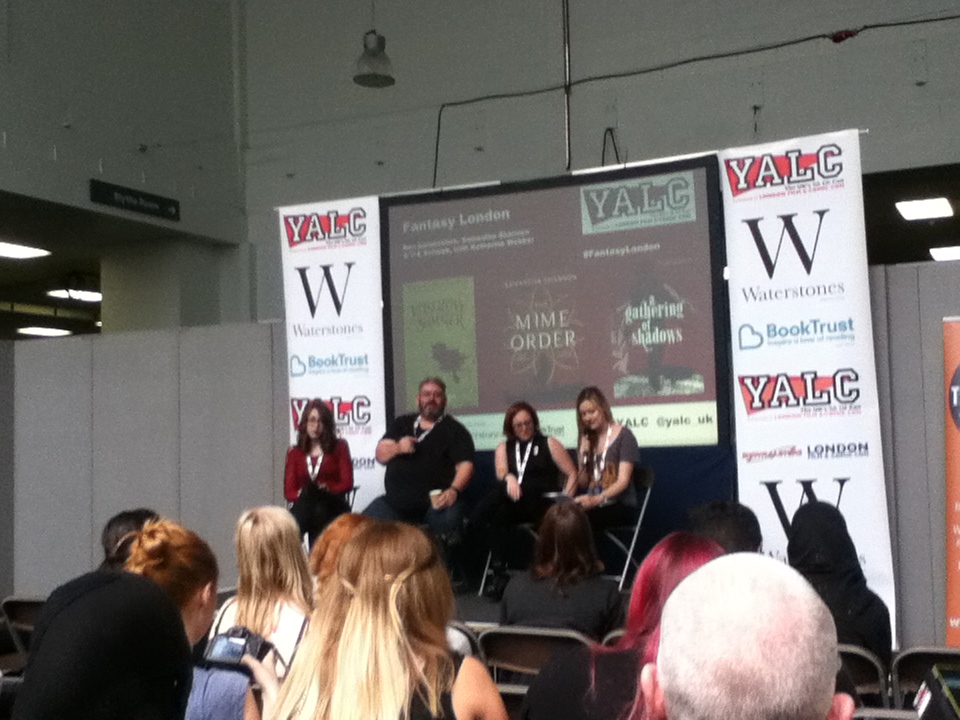
From left to right: Samantha, Ben, Victoria and Katherine.
The authors then
talked us through their use of real, historical and imagined landmarks, and
gave us some insight into their individual research methods. Victoria told us
that all her versions of London contain the River Thames as a common thread,
whilst Samantha spoke of a real mix of what used to exist with what actually
exists now. Ben has a ninety percent rule, where ninety percent of it is
completely real. He wants to know where his characters are eating, and he wants
that restaurant to exist. He wants it to be as real as possible. In terms of
research, Samantha likes to visit the cities she is writing about and she loves
to just walk around London and experience it first-hand. Victoria crossed the
pond to tread every step her main character steps, in order to make it real.
Would it be possible to walk from X to Y in so many minutes? And Ben takes a
more laid back approach, using Internet tools, his own knowledge and the
knowledge of his friends and acquaintances, mixed with research outings and
photographs.
All the authors
have had serious interest from Film and TV, which is definitely exciting for
the authors themselves and for the many fans of the series'. They also
discussed fights in their books and the different ways they approached them.
Victoria has been on hand-to-hand combat courses and likes to choreograph every
move of the fight, whereas Ben's main character avoids fighting where possible
and usually just hits people over the head with things. Samantha's main
character can possess anyone so has little need to fight, but one of her main
fight scenes did include about twenty people and again had to be carefully
plotted out. They finished with talk of where their characters were going next,
and the general consensus was, out of London. In the case of Samantha she is
gradually taking her dystopia on a global scale. Watch this
space.
Questions were
then thrown out to the audience, where we got to hear about their daily
motivational struggles, and the need for diversity and responsibility in their
writing. This was a great panel as I'm sure anyone in attendance would agree.
And there are definitely a few books added to the already huge reading
list.
Event:
Michael Grant in Conversation.
This was a
hilarious event with the wonderful Irish brogue of David O'Callaghan asking
the questions, and Michael Grant's razor sharp wit cutting the answers.
The main focus of
the conversation was around his newest series: Front Lines. This World War Two
series, centres around three women soldiers and their efforts in the war. His
decision to have a Supreme Court ruling where women would also be subject to
the draft and African American troops were called up earlier, were the only
changes he made to history. He wanted to stick close to the actual events of
the war, but to explore gender and race, and shine a light on events in a
different way. Being a huge fan of non-fiction, he was desperate to get all the
facts correct and do the least damage to history, whilst honestly telling the
story he wanted to tell. It's definitely
another on the reading pile. Michael's research brought him to London, but has
also taken him to France and Germany. He wanted to see the places where those
historical battles took place.
Then David led us
through some more general questions around Michael's preference of music during
writing, any quirks or weird habits, and whether or not he has a cabinet full
of terrifying situations and superpowers just waiting to be used on his
characters. Micheal admitted to not being able to listen to music whilst
writing Front Lines, but that in the Gone Series and BZRK he
would often listen to punk, especially when writing an action scene. He likes
to write out of doors, for three hours a day and he likes to smoke a cigar. And
in terms of violence, he wants to be authentic and show the consequences of
that violence. He admits to not being a great planner, and that he mainly
writes seat of the pants style. Interestingly, he also likes to have a visual
representation for his characters, so he finds pictures of locations and people
that fit his story. Whilst saying he doesn't plan, he did admit to keeping a
series bible, whilst working on certain projects, detailing everything from
class schedules and ferry schedules, to how many steps a blind character had to
take to get around.

Left to right: Michael Grant and David O'Callaghan

He was a great
talker and so funny. This was another fabulous event and a chance to see a
titan of the YA world up close and personal. Here are a few of my favourite
quotes from the event:
On writing: 'I'm here to keep you up all night.'
On reading: 'Read for fun.' 'I read everything.' 'Read what you find
interesting.'
'Of course,
Stephen King. You can't not read Stephen King.'
YA, what is too
much?: 'I
don't think books hurt people.'
'It's not
my job to protect you. You protect yourselves.'
Questions from the
audience shed further light on Front Lines as a series and also involved a
discussion on diversity, where Michael basically said, if you're not using
diverse characters and drawing on real life, then you are essentially
diminishing your cast members and limiting your story. It should involve
everyone, because life is made up of lots of interesting characters from every
walk of life.
Event: My
Teen Diary
Hosted by Juno
Dawson and Lisa Williamson, this was the final event of YALC Day
1, and if you weren't there, it would probably be difficult to convey just how
funny it was, but I'll give it a whirl. We were treated to excerpts from nine
authors' teen diaries, and it was, as you can probably imagine, hilarious. I
will treat you to some of the best bits that I managed to scribble down.
Lisa Williamson
kicked us off, with her sixth form diary from 1997. She talked of singing the
Power Rangers theme tune in her head during the Remembrance Day silence. She
referred to Hanson's Mmm Bop and told of her mum cutting her
fringe way too short. (I can relate to that one.)


Juno Dawson and Lisa Williamson
Then Natasha Farrant gave
us a very different feel with her University diary from 1990 and the start of
the Gulf War. IRA bombings, worry for her country and the countries at war, and
evacuated tube stations, all played a part, but we were also let in on a secret
code: very happy = I've had lots of sex.
Next up Liz Flanagan gave
us a taste of A-levels, in her diaries from age 16-19. She talked of exam
stress, her Jane Eyre/Bronte obsession, and being stoned at Glastonbury. There
was some big best friend love going around and even a bit of washing her
knickers in the sink.
Deirdre Sullivan gave us a couple of time frames,
with an excerpt from her diary aged 13, and an excerpt from her diary aged 17.
At 13 there were more Hanson references, swearing at cars, and posing for imaginary
photographs. And her later diary showed her pissed off at the world, and the
drama of a pregnant friend who wasn't sure who the father was.
Nicole Berstein
gave us a glimpse into 14 year old Nicole's life from 1998. She named her diary
after her dead dog, Sophie. And she desperately wanted a gerbil. There was even
a hefty pros and cons list.
Honour Cargill was
the youngest and possibly bravest author to step up to the diary challenge as
she's only 18 now, so this was all very recent. Her excerpts started from aged
10 up to the present. She told us of a family ski trip described through some
pretty dark metaphors and similes and admitted to partly transcribing some of
her diary into the Russian alphabet in case her mum found it.
Claire Hennessy's diary from her late teens, written in
the early noughties was actually taken from an online
journal where you could input current mood and an emoticon. Whilst reading it
she exclaimed, 'Oh god, I haven't changed.' Can we ever think of an optician’s
room in the same way ever again? Are optician rooms sexy? Apparently so.
Jenny McLachlan took us on an inter-rail trip
from when she was 18. They took lifts with strangers, had their photograph
taken by the same strangers, ate spaghetti bolognese and drank three beers. 'Smashing.'
Harriet Reuter-Hapgood finished
off the event with her musings from the year 2000, aged 18. There were
descriptions of sofa closeness with a boy, who gave lots of sofa flirting. She
was scared of eating in front of people, and she admitted to being a bit of a
prude.
Well done to all
the authors who bore their teenage souls to the audience. It made me go back
and read some of mine. Oh dear. Oh dear.
So there we have
it, the roundup of YALC Day
1, 2016. So many authors, so many books to read, so many worlds to explore, so
many stories still to be told. A magical and often hilarious day, this year's YALC had
a massive turn out of UK and international authors and a huge thanks to all of
them for attending and imparting wisdom. I'm glad to say that after a few
episodes of Netflix's Stranger Things, I finally understand
Juno Dawson's cosplay. Very
nicely done Juno. You made a great Eleven. And I will be back
soon with Day 2 and 3 of YALC, if I
can get my act together and stop binge watching Gilmore Girls.
Thanks for reading
and I hope I've inspired you to pick up a new book or try a new author.
Rants
Subscribe to:
Posts (Atom)